
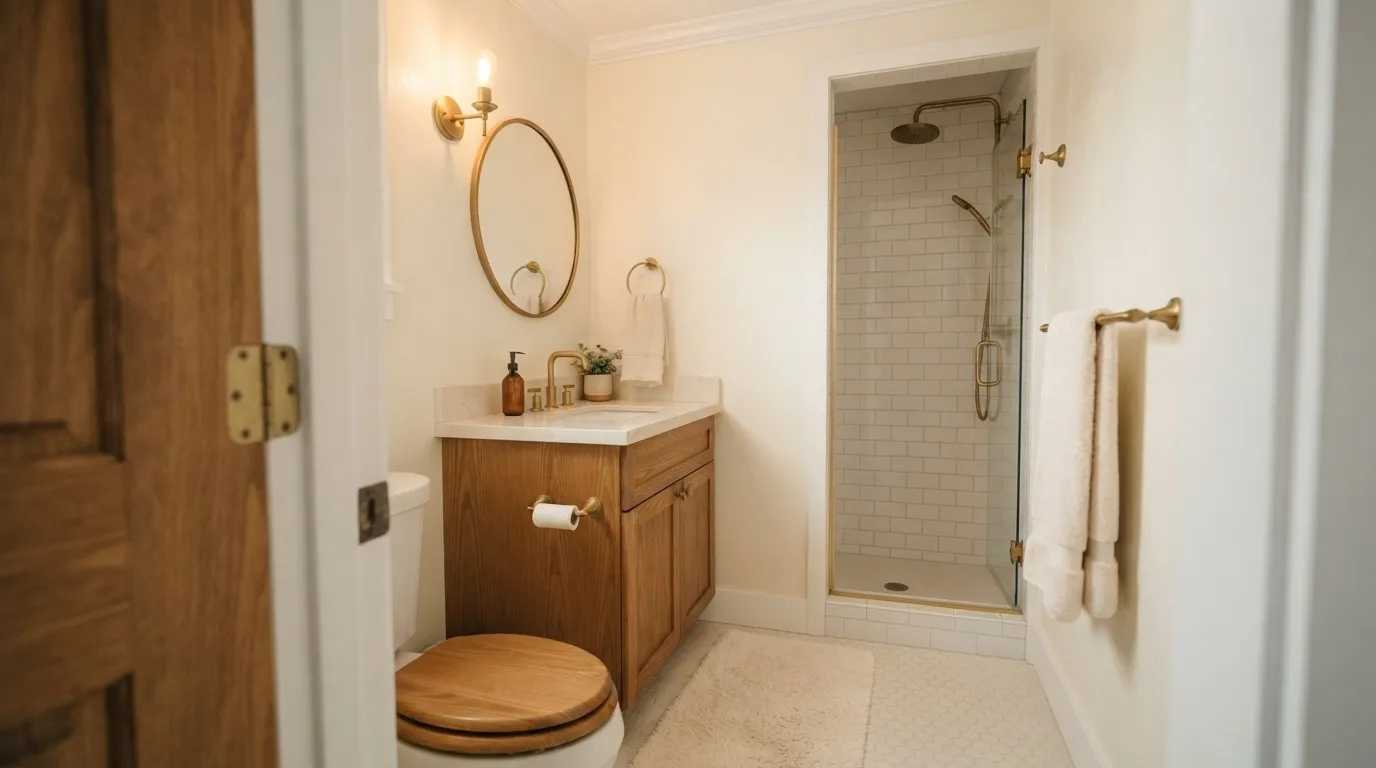

A small bathroom doesn’t have to default to plain white just because square footage is tight. In fact, the right color scheme can expand a room far more effectively than any layout change ever could. The best bathroom color schemes generally work in one of two directions, either maximizing reflected light to visually stretch the walls outward, or leaning fully into the smallness with a bold, jewel box effect that turns the room into an intentional little retreat. Let’s walk through 10 real color scheme options covering both strategies.
Scheme 1: Creamy White Over Sterile White
Pure white might seem like the obvious safe choice, but it can turn harsh under LED lighting, especially with cooler bulbs. Creamy white, with a hint of beige, ivory, or linen underneath, feels considerably softer and handles shadows more gracefully. It pairs naturally with warm cabinet stains and brass fixtures too, both of which continue to trend heavily. This remains one of the most popular bathroom color schemes for good reason, it’s timeless, resale friendly, and genuinely hard to get wrong.
Scheme 2: Soft Sage Green
Sage has become one of the clearest trending bathroom colors for 2026, and it’s easy to see why once you try it. Kept muted rather than saturated, sage adds real color to a small bathroom without visually shrinking the room the way a darker olive tone might. It’s flexible enough to work in nearly any small space, which explains its rise across bathroom color schemes for small bathrooms everywhere.
Scheme 3: Gray Blue or Mist Blue
Blue has always been a reliable choice, but the better versions for 2026 lean toward gray blue and mist blue rather than bright aqua or deeply saturated navy. These softer tones read clean and relaxed without overwhelming a tight space. One important detail here, keep the undertones consistent between your wall paint and your tile, since a cool blue wall paired with warm yellow toned tile tends to look mismatched rather than intentional.
Scheme 4: High LRV Neutrals, the Light Maximizing Strategy
This is the classic, tried and true approach to making any small room feel bigger. LRV stands for light reflectance value, and the higher that number, the more light a color bounces back into the room rather than absorbing it. Look for a pale greige, a soft alabaster white, or a warm sea salt toned neutral, all of which sit high on the LRV scale. If your main goal is the traditional expanding effect, this strategy is your most dependable bet.
Scheme 5: Blush and Mint Pastels
Muted pastels bring a cozy, spacious feeling without falling into the plainness that an all neutral room sometimes has. Blush pairs beautifully with brushed gold or brass hardware, giving the space a soft, elevated look. Mint, on the other hand, works especially well against classic white subway tile, striking a nice balance between playful and calm.
Scheme 6: Mushroom and Lilac
This pairing sounds unexpected on paper, but it’s genuinely one of the best bathroom color schemes for small spaces once you see it in person. Mushroom functions almost like a sophisticated neutral, quietly grounding the room, which lets a soft lilac accent wall or vanity color feel intentional rather than overwhelming against it.
Scheme 7: The Jewel Box Strategy, Deep Saturated Color
Here’s the counterintuitive approach worth considering. Instead of trying to expand the room with light colors, you lean fully into its smallness with a bold, saturated shade, a deep navy, an iron toned charcoal, or a rich pewter green. Done well, the room stops trying to hide its size and instead feels like a deliberate, cocoon like retreat. This approach works best in powder rooms with good layered lighting, rather than a bathroom relying on a single overhead fixture, since dark colors need enough light sources to avoid flattening the space entirely.
Scheme 8: Earthy Color Pairings
One of 2026’s biggest bathroom trends involves pairing two nature inspired tones together rather than sticking to one dominant color. Think stone gray alongside grassy green, or warm terracotta paired with a soft eucalyptus. The key to pulling this off in a small space is keeping one tone muted while treating the other as more of an accent, so the pairing complements the room instead of competing for attention within it.
Scheme 9: Terracotta as an Accent, Not a Full Room Color
Muted terracotta brings genuine warmth and personality, but covering an entire small bathroom in it can start to feel heavy fast. Used instead on a vanity, a single accent wall, or trim work, it adds character without overwhelming the space. It’s a smart, low commitment way to bring color into the room if you’re not ready to fully commit to a bolder scheme.
Scheme 10: Light and Contrast Combination
Here’s a trick worth borrowing from professional designers. Keep your walls light and airy to maximize brightness, then introduce contrast through a darker grout line, a textured shower curtain, or updated cabinet hardware. The light color does the heavy lifting for expanding the room visually, while the contrast keeps everything from feeling flat, bland, or forgettable.
How to Actually Choose Between These
Before committing to any scheme, test it as a painted swatch across two walls rather than trusting a small paint chip, and view it morning, midday, and at night under your actual bulbs, since lighting changes a color dramatically throughout the day. If you want something timeless and resale friendly, lean toward creamy white or soft sage. If you want more personality, an earthy pairing or the jewel box approach delivers that. And if the classic expanding effect is your main priority, a high LRV neutral remains your safest, most dependable choice.
Once you’ve settled on a direction, sourcing the actual paint, fixtures, and finishing touches is where a bit of extra help goes a long way. The Home Gardenist regularly features discounts, coupons, and savings across a wide range of home decor and bathroom brands, making it easier to pull together your chosen color scheme without paying full price at every stop.
The Bottom Line
The best bathroom color schemes for small bathrooms come down to picking one clear strategy, expand the space with light, or embrace the cozy, jewel box feel, rather than mixing signals halfway between the two. Whichever direction you choose, test your top pick physically before committing, since lighting changes everything once it hits an actual small space rather than a paint swatch in your hand.