
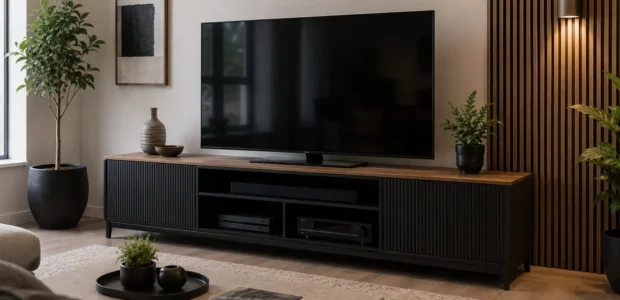

Buying a TV stand seems like it should be simple, right up until you’re standing in front of one in a store, trying to picture whether it’ll look right at home or completely swallow the wall behind your television. The good news is that getting this right isn’t really about instinct or guesswork, it comes down to a handful of reliable formulas that take the uncertainty out of the decision entirely. Let’s walk through a full buying guide covering size, height, storage, and a couple of details most guides skip over completely.
Get the Width Right First
Start with the number that matters most. Your tv stand should generally be somewhere between 3 and 6 inches wider than your TV on each side, giving the screen visual breathing room instead of looking cramped or overhanging the edges. As a quick reference, a 55 inch TV pairs well with a stand around 54 to 66 inches wide. A 65 inch TV suits something closer to 63 to 78 inches. A 75 inch TV works best with a stand in the 72 to 84 inch range.
If you find yourself stuck between two sizes, size up. Extra surface space rarely turns into regret, while a stand that’s slightly too narrow tends to feel like a mistake the moment your TV goes on top of it.
Nail the Height for Comfortable Viewing
Height gets overlooked far more often than width, but it matters just as much for actual comfort. The general rule is simple, the middle of your screen should land roughly at eye level when you’re seated on your couch. In practical terms, that usually puts the TV’s center somewhere between 40 and 48 inches from the floor, though the exact number shifts depending on how tall your sofa sits.
The best way to nail this is to actually sit down, measure your seated eye level, and use that real number rather than eyeballing it from across the room. This single step prevents one of the most common setup regrets, a TV mounted or placed just a bit too high or low for genuinely comfortable viewing.
Choose the Right Style of TV Stand and Media Console
Once size and height are sorted, style becomes the next decision. Open tv stands, with exposed shelving and no doors, suit minimal, streaming focused setups where you don’t have much gear to hide, just a TV, a streaming box, and maybe a soundbar. Closed media consoles bring doors and drawers into the mix, ideal for households juggling game consoles, cable boxes, or a stack of controllers that would otherwise sit in full view.
Hybrid entertainment consoles split the difference, combining open shelving with closed storage in one piece. For most busy households, this is genuinely the most flexible option, giving you a place to tuck away clutter while still keeping frequently used devices within easy reach.
Don’t Skip Depth and Storage Details
Depth is easy to overlook, but it directly affects whether your equipment actually fits comfortably. A typical depth range of 15 to 20 inches accommodates most AV equipment without crowding everything together or leaving gear hanging off the edge.
Beyond the overall dimensions, check the actual shelf opening sizes if you’re housing a receiver or game console, and look at drawer depth if you’re planning to store remotes or controllers inside. Cable management deserves attention too, look for pass through holes, ideally two or more, so cords stay tucked out of sight instead of tangling across the back of the unit.
What Most Guides Skip: Buy for Tomorrow’s TV, Not Just Today’s
Here’s a detail that rarely gets mentioned, but it can save you from an unnecessary repurchase down the road. Plenty of households upgrade their TV size within just a few years, so sizing your tv stand modern purchase slightly larger than strictly necessary today can save you from replacing the furniture alongside your next TV upgrade.
If you’re torn between two width ranges while shopping, lean toward the size that would also comfortably fit a TV one size class up from what you currently own. It’s a small adjustment now that pays off considerably later.
The Other Standout Tip: Small Details That Matter in a Modern Home
A few practical details tend to get missed in most standard buying guides, but they matter a lot in a genuinely modern setup. Ventilation clearance behind the console matters for AV receivers and streaming boxes, since these can overheat if they’re crammed into a tight, closed space without airflow. If you use a robot vacuum, check for recessed base clearance too, a small detail, but a genuinely useful one for keeping your floors clean without your furniture getting in the way.
Weight capacity is worth checking as well, especially if you’re planning to mount a soundbar or add a shelf that puts extra load on the surface. It’s an easy detail to overlook until something starts to sag.
Once you know what you’re looking for, sourcing the right piece is where a little extra help goes a long way. The Home Gardenist regularly features discounts, coupons, and savings across a wide range of furniture brands, covering everything from budget friendly stands and modern media consoles to higher end statement pieces, making it easier to find the right tv stand and media console for your space without paying full price.
The Bottom Line
Choosing the right tv stand and media console really comes down to a few core factors, width, height, storage style, and a bit of future planning for your next TV upgrade. Measure twice, size up when you’re unsure, and the setup you choose today will comfortably serve your living room well past your next television upgrade.