
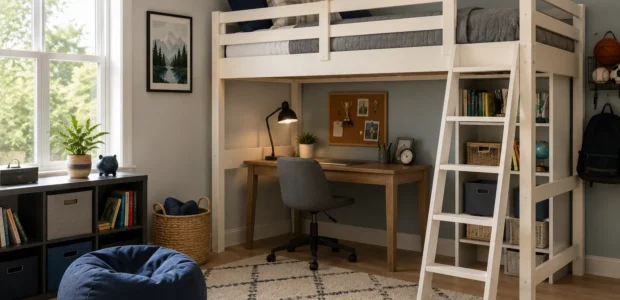

Kids loft beds look like the perfect solution the moment you start running out of floor space. Tuck the bed up top, add a desk or a play area underneath, and suddenly a cramped room feels twice as big. But before you start shopping, there is one question worth slowing down for: is your child actually ready for one?
Age is the starting point, but it is not the whole story. Height, maturity, and the specific bed you choose all play a role too. Let’s walk through what the real guidelines say, so you can make this call with confidence instead of guesswork.
The Standard Age Guideline: Six and Up
Most safety organizations, including the Consumer Product Safety Commission, point to age six as the general minimum for a loft bed or a top bunk. Before that age, most kids simply do not have the coordination, balance, or nighttime spatial awareness needed to climb up and down a ladder safely, especially if they wake up disoriented in the dark.
This is not just a cautious guess either. A large share of bunk and loft bed emergency room visits involve children under six, which is exactly why this age keeps showing up as the standard across manufacturer guidelines and safety groups alike. If you are wondering about the general age for loft bed use, six is where most experts land.
The Exception: Low Loft Beds for Kids as Young as Four
That said, there is a reasonable middle ground for younger kids who are eager for a raised bed. Low loft beds for kids, generally sitting somewhere between three and four feet off the floor, can work for children as young as four, but only under the right conditions.
The two things that matter most here are full length guardrails running along all four sides, and a staircase instead of a vertical ladder. Stairs are simply easier and safer for smaller kids to navigate, especially half asleep at two in the morning. If you are set on starting with childrens bedroom loft beds early, this is the safer route to take.
Height of a Loft Bed: What the Numbers Actually Mean
Loft beds generally fall into a few height categories, and knowing them helps a lot when comparing options. A low loft sits around three feet off the ground and suits kids close to six. A mid loft is roughly ten inches taller and tends to work well around age eight, since it leaves enough room underneath for a small desk or storage bins. High lofts are built for tweens and teens, standing much taller and offering the most usable space below.
Ceiling clearance matters just as much as the bed itself. As a general rule, aim for around 33 to 36 inches of space between the top of the mattress and the ceiling, giving your child enough room to sit up comfortably. Before choosing a bed based on style alone, measure your child’s actual room and ceiling height first, it will save you from returning a bed that simply does not fit.
Beyond Age: Signs Your Child Is Actually Ready
Age gives you a starting point, but it is not the full picture. Watch for real signs of readiness too, like whether your child climbs stairs or ladders confidently, follows safety instructions consistently, and does not wander around confused if they wake up in the middle of the night.
A mature five year old might genuinely be more ready than a hesitant eight year old, so treat the age guideline as a floor, not a guarantee. If your child shows real caution and coordination, that behavior tells you more than their birthday does.
Full Size Loft Beds: A Note for Older Kids
As kids grow, a twin sized loft bed can start to feel tight, which is where a full size loft bed or full size low loft bed comes in. These give older kids and tweens more mattress space while still preserving the floor space benefits underneath for a desk, reading nook, or extra storage.
Even with older children, it is worth double checking weight limits and guardrail height before making the switch, since safety standards still apply no matter how independent your child has become.
Once you know which loft bed height and style fits your child, the next step is picking the right mattress to go with it, and that is where The Home Gardenist can help. We carry a wide range of trusted mattress brands alongside our furniture and bedroom decor picks, and we regularly feature discounts, coupons, and savings across the site, so you can outfit the whole setup, bed and mattress included, without stretching your budget.
The Bottom Line
Six is the general rule of thumb, low loft beds can safely bend that rule from age four with the right guardrails and stairs, and maturity always matters just as much as the number on a birthday cake. Measure the room, watch how your child handles stairs and instructions, and choose a structure that actually fits their age and personality. Get those pieces right, and a loft bed becomes exactly what it promises, more room to grow into, safely.