
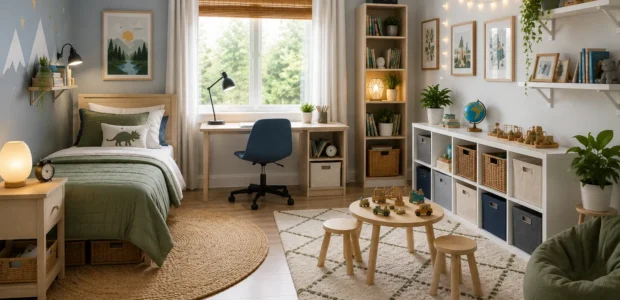

One small room, three completely different jobs. It needs to help your child fall asleep at night, give them room to play during the day, and become a focused spot for homework for a few hours. No wonder kids’ rooms feel chaotic so often. But the fix isn’t buying more furniture, it is giving each job its own clear space.
This idea of zoning is really the foundation of good interior design for children’s room layouts, and once you see it, it changes how you approach the whole space.
Why Zoning Matters More Than Decorating
Kids do better with visual boundaries than adults might expect. When toys, homework papers, and bedding blur together in one corner, it gets harder for a child to shift between resting, playing, and focusing. A cluttered, mixed use layout can quietly work against bedtime routines and calm play, even if the room looks cute in photos.
Zones do not need actual walls to work. A rug, a bookshelf turned sideways, a curtain, or a shift in wall color can signal “this area is for something different.” That single idea, clear separation without extra square footage, is the backbone of almost every solid kids bedroom design.
The Sleep Zone: Keep It Calm and Separate
Start with the bed, the anchor of the whole room. Place it away from the busiest, loudest part of the space, ideally somewhere removed from the chaos of playtime. Blackout curtains help control light for better sleep, and softer lighting nearby, like a small lamp instead of an overhead light, makes bedtime feel calmer.
Keep this zone simple. A nightstand for a book and a comfort item is plenty. The more toys and school supplies creep toward the bed, the harder it becomes for your child’s brain to associate that spot with actual rest.
The Study Zone: Small but Focused
You do not need a huge homework corner, even a compact desk, chair, lamp, and small bookcase is enough. Facing the desk toward a wall reduces distractions for easily distracted kids, while a spot near a window works well for kids who focus better with natural light.
What matters most is that this area feels different from the play zone, even a few feet away. When the desk has its own identity, sitting down at it signals “focus time” almost automatically.
The Play Zone: Open, Soft, and Easy to Reset
A simple rug or a set of foam floor tiles marks off a play area, even without walls or furniture. It gives your child a defined spot to spread out toys and get creative, and makes cleanup more manageable too.
Keep storage at your child’s height, using low bins or open baskets they can reach on their own. This encourages independence, since kids can put things away themselves instead of relying on you every time. Keep this area physically separate from the bed, reinforcing that one spot is for rest and the other is for energy and imagination.
Making Small Rooms Work: Smart, Space Saving Furniture
If square footage is tight, a loft or mid sleeper bed can change what is possible in the room. Raising the bed frees up the floor underneath for a desk, a play corner, or extra storage, letting all three zones exist without needing three times the space.
Vertical storage helps too. Tall bookcases and wall mounted shelves keep the floor open for play while still giving your child room for books and belongings. In small rooms especially, furniture that pulls double duty, like a bed with built in drawers, makes a real difference.
Designing for Shared Rooms, and Letting the Room Grow
When two kids share a room, the same zoning principles apply, just doubled. Give each child their own small version of a sleep, play, and study area where possible. A curtain, a bookshelf used as a divider, or different colored bedding can mark personal space without splitting the room in half. Bunk beds are especially useful here, since stacking the sleeping area frees up floor space for a shared play zone or two small desks side by side.
It is also tempting to buy adorable, child sized furniture, but kids outgrow it fast. Choosing pieces that adapt over time, like a desk that works from early school years through the teens, or storage that shifts easily from toys to books, saves you from redoing the whole room every couple of years.
Once you know how each zone should function, pulling together the right furniture, mattress, and finishing touches is where The Home Gardenist can help. We carry a wide range of trusted mattress brands along with furniture, storage, and decor from other household interior brands, all in one place. We also feature discounts, coupons, and savings throughout the site, so you can furnish each zone of your child’s room without stretching your budget too far.
The Bottom Line
A great kids’ room does not come down to more stuff, it comes down to clear zones that support what your child needs to do in that space. Start with one zone if a full redesign feels like too much, get the sleep area calm and separate first, then build out play and study around it. The room will feel more organized almost immediately, and so will your child’s day.